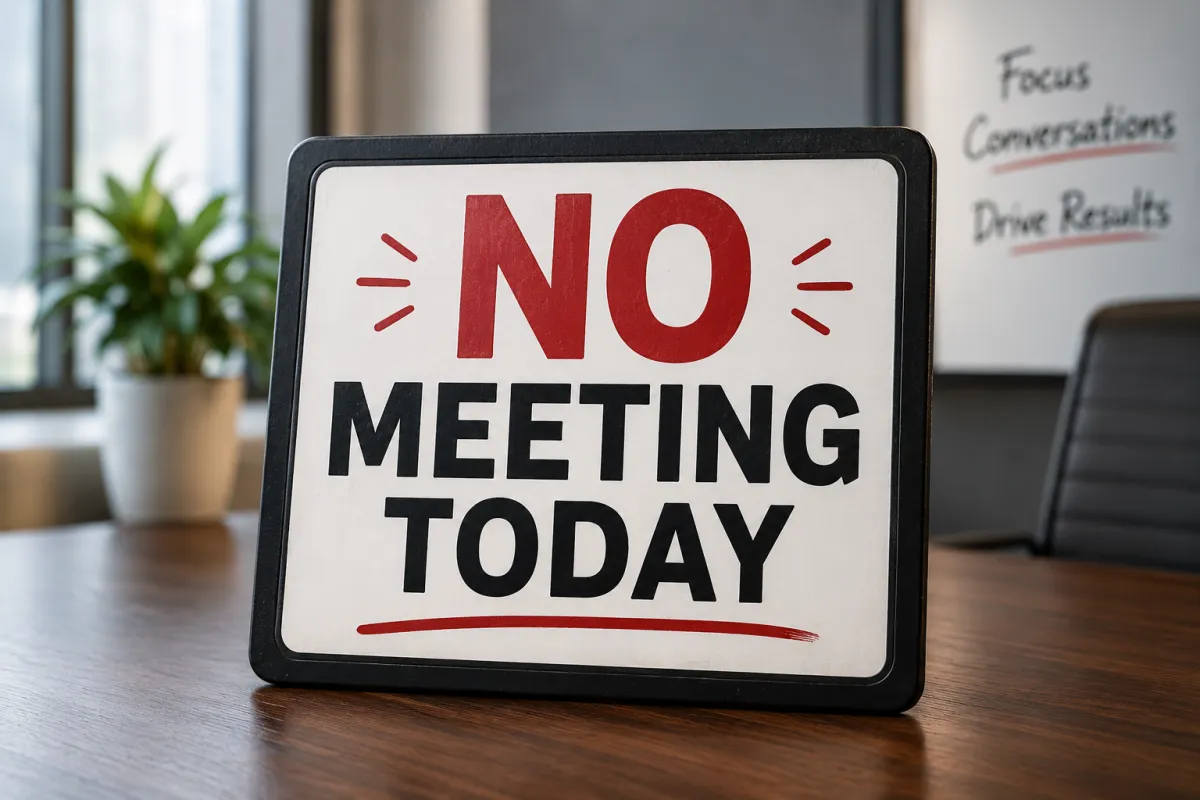
Why Your Team Doesn't Need More Meetings—They Need Better Conversations
Why Your Team Doesn't Need More Meetings—They Need Better Conversations
If you asked employees to name the biggest obstacle to getting meaningful work done, there's a good chance one answer would appear near the top of the list:
Too many meetings.
It's one of the great paradoxes of modern business. Organizations have never spent more time communicating, yet many have never struggled more with alignment, accountability, or execution.
Calendars are packed. Teams meet weekly, daily, and sometimes hourly. Status updates fill inboxes. Collaboration platforms buzz nonstop.
And yet leaders still find themselves asking: "Why isn't everyone on the same page?"
The problem isn't a lack of communication. The problem is a lack of meaningful conversation.
Organizations are drowning in communication while starving for conversations that actually change behavior.
More Meetings Don't Equal Better Leadership
Not long ago, I was speaking with a senior executive who looked exhausted.
He said, "I spend almost my entire day in meetings, but I still feel like I'm chasing the same problems every week."
His experience isn't unique.
Many meetings become predictable routines.
The leader provides updates. Someone reviews metrics. A few people offer comments. Action items are assigned. Everyone leaves.
Then the exact same issues reappear the following week.
The meeting happened. But the conversation never did.
There's a difference.
Meetings exchange information. Conversations create transformation.
Information tells people what happened. Conversations help people understand why it happened, what should happen next, and who will own the outcome.
That's where leadership lives.
The Cost of Meeting Overload
Research continues to highlight the hidden costs of excessive meetings.
Studies from organizations such as Microsoft and other workplace researchers have shown that employees are spending significantly more time in meetings than they did just a few years ago. As meeting volume increases, uninterrupted focus time declines, decision fatigue grows, and productivity suffers.
Ironically, many organizations respond to execution problems by scheduling...another meeting.
But adding another meeting rarely solves an accountability problem.
Another meeting won't create ownership. Another presentation won't build trust. Another status report won't inspire innovation.
What changes results are the conversations happening inside those meetings.
I Learned This at Disney
Years ago, while working in operations at Walt Disney World, I learned an invaluable lesson.
Our team was constantly looking for ways to improve productivity. We reviewed reports. We analyzed data. We discussed performance metrics.
Then I asked one frontline employee a simple question:
"If you could change one thing about your job immediately, what would it be?"
She immediately shared three ideas that leadership had never considered.
Within weeks, implementing those ideas increased productivity by more than 12 percent.
We didn't schedule another committee meeting. We didn't launch a task force.
We had one conversation.
The insight wasn't hidden. It simply hadn't been invited.
That experience changed how I viewed leadership forever.
The greatest opportunities in an organization are often discovered through questions, not presentations.
Replace Status Updates with Strategic Conversations
I've become convinced that the purpose of a meeting should not simply be to exchange information.
Its purpose should be to improve thinking.
That's why I encourage leaders to shift from what I call meeting management to conversation leadership.
Rather than asking: "What do I need to tell everyone?"
Ask: "What conversation does this team need to have today?"
That single shift changes everything.
Instead of reviewing problems, teams begin solving them. Instead of waiting for direction, employees begin contributing ideas. Instead of passive participation, ownership grows.
I've found that the best meetings consistently create one or more of the following outcomes:
Greater clarity.
Better decisions.
Stronger accountability.
New ideas.
Clear commitments.
If none of those happen, the meeting probably wasn't necessary.
Three Questions That Transform Meetings
You don't need a completely new meeting format to create better conversations.
Start by asking better questions.
1. "What's getting in the way of our success?"
Instead of reviewing completed tasks, uncover obstacles before they become bigger problems.
2. "What are we not seeing?"
This question encourages fresh thinking, surfaces blind spots, and creates psychological safety for people to raise concerns.
3. "What should we stop doing, start doing, and continue doing?"
It's one of the simplest—and most effective—questions a leader can ask. It simultaneously creates reflection, accountability, continuous improvement, and ownership.
Notice something about all three questions.
None of them begin with the leader providing answers. They begin by inviting contribution.
That's the hallmark of great leadership.
Meetings Should Produce More Than Minutes
Most organizations evaluate meetings by asking whether everyone attended.
A better question is: Did everyone think?
Because thinking produces innovation. Thinking produces ownership. Thinking produces engagement. Thinking produces better execution.
The most valuable outcome of any meeting isn't a set of notes.
It's a group of people leaving with greater clarity, stronger commitment, and a shared determination to move forward.
That's what conversations accomplish.
One Conversation Can Replace Ten Meetings
The next time you're tempted to schedule another meeting, pause for a moment.
Ask yourself: Is this really a meeting problem, or is it a conversation problem?
You may discover that your team doesn't need another hour together.
They need one courageous question. One honest discussion. One meaningful conversation that creates clarity, ownership, and action.
Because leadership isn't measured by how many meetings you hold.
It's measured by the conversations that move people—and results—forward.
Leadership happens one conversation at a time.
