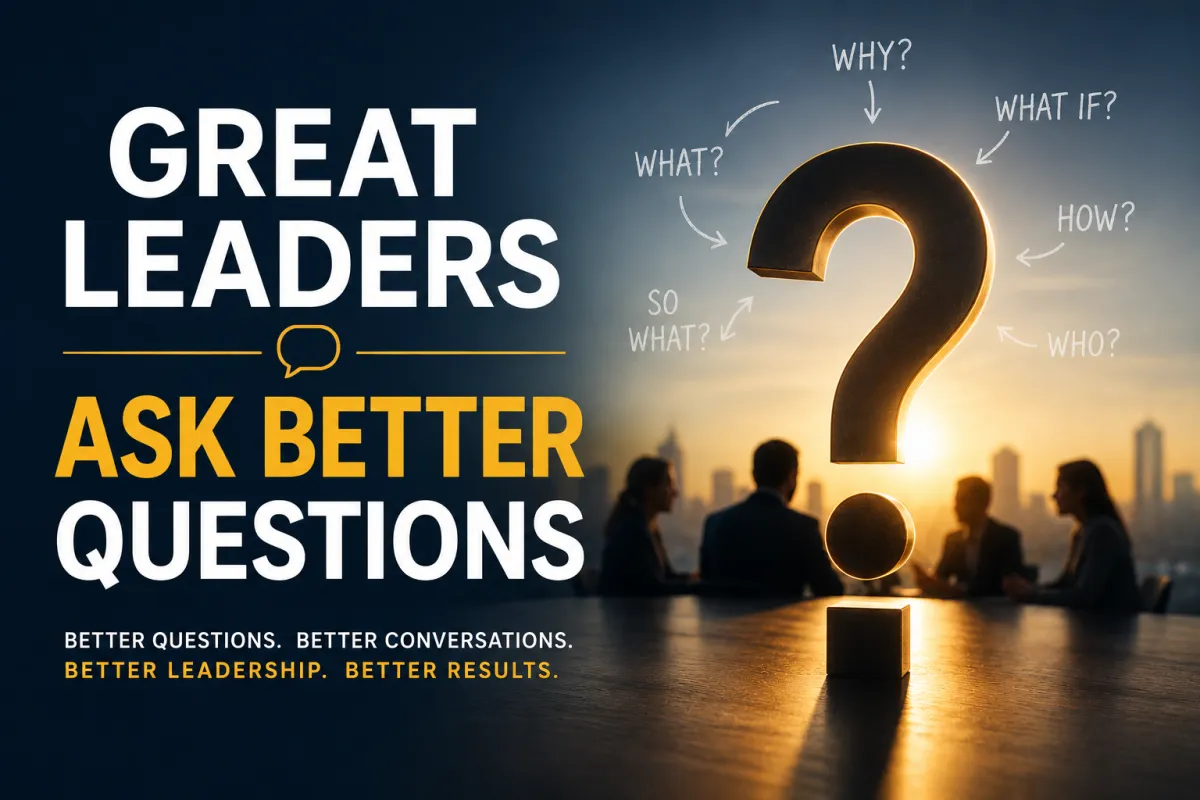
The Best Leaders Don't Have Better Answers—They Ask Better Questions
The Best Leaders Don't Have Better Answers—They Ask Better Questions
One of the biggest myths in leadership is that the person with the most answers is the best leader.
It's an understandable assumption.
Most people are promoted because they have expertise. They know the business, solve problems quickly, and consistently deliver results. Their ability to produce answers is exactly what helped them become successful.
Ironically, that's often what limits them once they begin leading others.
The very skill that earned the promotion can quietly become the obstacle to developing the people around them.
I've watched it happen repeatedly.
A leader answers every question.
Solves every problem.
Makes every decision.
Approves every idea.
The team becomes faster at asking the boss than thinking for themselves.
At first, everyone celebrates how responsive the leader is.
Eventually, everyone wonders why the leader is overwhelmed.
The Leadership Trap
Years ago, I watched an executive spend nearly every day solving problems that his team should have been solving.
His calendar was packed.
His email never stopped.
Employees lined up outside his office because they knew he always had the answer.
He was proud of being indispensable.
But there was a hidden cost.
Every answer he provided prevented someone else from developing the ability to solve that problem in the future.
His expertise had unintentionally become a bottleneck.
Many leaders fall into the same trap.
They believe they're helping.
In reality, they're creating dependence.
Leadership isn't measured by how many problems you solve.
It's measured by how many problem-solvers you develop.
The Question That Changed My Leadership
Early in my Disney career, I had a manager named Djuan Rivers.
I was young, eager, and determined to impress.
One afternoon he gave me feedback that completely changed how I viewed leadership.
He could have simply told me what I was doing wrong.
Instead, he asked questions.
He asked what I was trying to accomplish.
He asked why I had chosen that approach.
He asked what I thought guests actually needed from the interaction.
By the end of the conversation, I had reached the conclusion myself.
Because I discovered the answer instead of receiving it, I never forgot the lesson.
Looking back, I realize Djuan wasn't merely correcting my performance.
He was developing my thinking.
That's what exceptional leaders do.
They don't just improve today's results.
They improve tomorrow's decision-makers.
Research Supports the Power of Questions
Daniel Pink, in his research on human motivation, argues that people are most motivated when they experience autonomy, mastery, and purpose.
Questions support all three.
When leaders ask thoughtful questions instead of immediately providing answers, they increase autonomy because employees participate in finding solutions.
They develop mastery because people think through increasingly complex problems.
And they strengthen purpose because employees become active contributors instead of passive recipients of instructions.
Questions don't slow performance.
Done well, they accelerate learning.
Why Leaders Default to Answers
Providing answers feels efficient.
Asking questions feels slower.
When deadlines are looming and customers are waiting, it's tempting to simply tell people what to do.
Sometimes that's exactly the right approach.
But if every challenge is met with another answer, something subtle begins to happen.
Employees stop preparing.
Why think deeply if the boss will eventually tell us what to do?
Innovation begins to fade.
Ownership declines.
The leader works harder while the team thinks less.
That's not leadership.
That's dependency disguised as productivity.
Three Questions Every Leader Should Ask More Often
The best leadership questions aren't complicated.
They're intentional.
Here are three that consistently produce better conversations.
1. "What options have you considered?"
This question communicates confidence.
It assumes the employee has already been thinking.
More often than not, they have.
2. "What's getting in the way?"
Poor performance is often treated as a motivation problem.
Sometimes it's actually a clarity problem.
Or a resource problem.
Or a process problem.
Questions uncover obstacles before leaders prescribe solutions.
3. "If you were leading this, what would you do?"
This is one of my favorite questions because it instantly changes perspective.
People stop defending the current situation and begin thinking like owners.
It's difficult to ask that question without engaging a higher level of thinking.
Questions Create Ownership
One of the central ideas behind my work is this:
Advice creates compliance. Questions create ownership.
Compliance is temporary.
Ownership lasts.
Employees support what they help create.
They commit more deeply to ideas they've helped shape.
And they execute more effectively when they've been invited to think instead of simply instructed to act.
That's why the best leaders don't measure the quality of a conversation by how much they talked.
They measure it by how much thinking they created in someone else.
Before You Give Your Next Answer...
The next time someone walks into your office with a problem, resist the urge to answer immediately.
Instead, pause.
Ask one thoughtful question.
Then another.
See where the conversation goes.
You may discover something surprising.
The person sitting across from you was capable of solving the problem all along.
They simply needed a leader who believed enough in them to ask instead of tell.
That's the difference between managing today's work and developing tomorrow's leaders.
And in the long run, organizations don't grow because leaders have all the answers.
They grow because leaders create environments where better questions become the catalyst for better thinking, better decisions, and better results.
