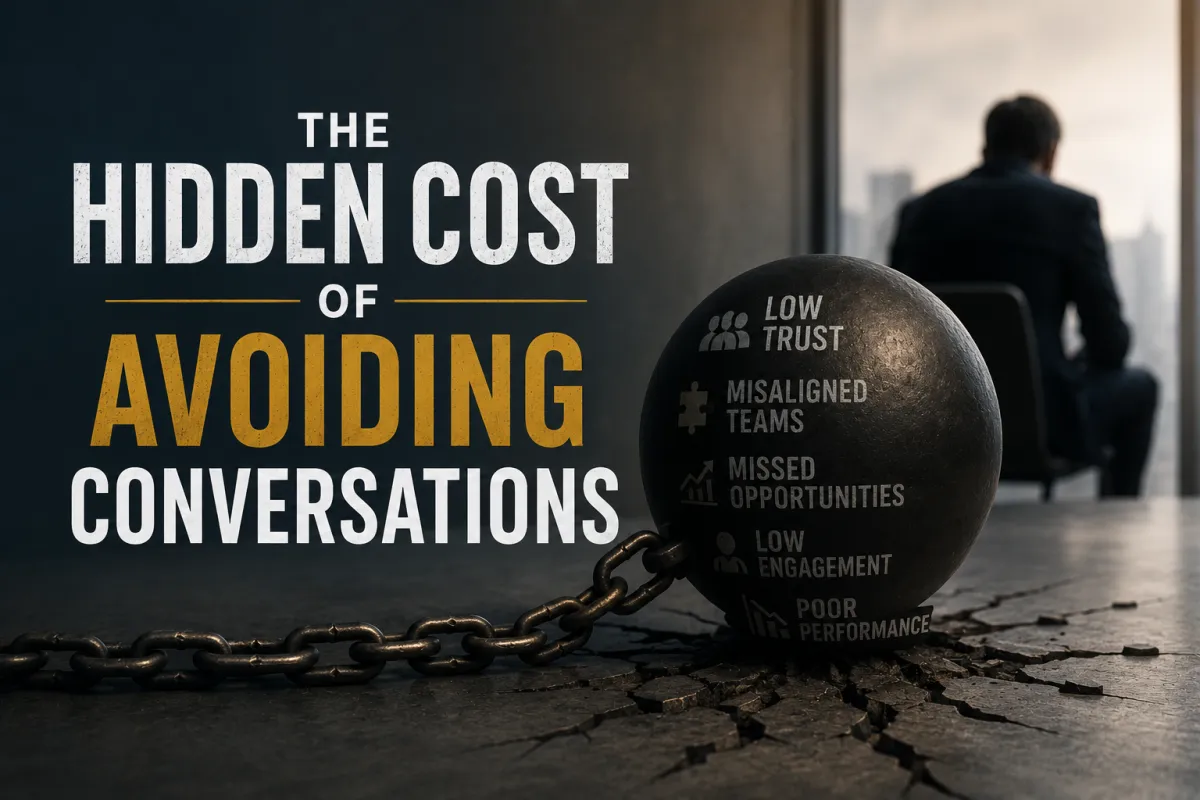
The Hidden Cost of Avoiding Important Conversations
The Hidden Cost of Avoiding Important Conversations
Every leader has one.
The conversation they know they need to have—but keep postponing.
Maybe it's the high performer whose attitude is poisoning the team.
Maybe it's the manager who consistently misses deadlines.
Maybe it's the employee who is quietly disengaging.
Or maybe it's the difficult discussion with a colleague that feels easier to avoid than address.
Whatever it is, most leaders know exactly which conversation they've been putting off.
The irony is that delaying the conversation often feels like the safer choice.
It isn't.
It's usually the most expensive choice.
The Cost of Waiting
In 2012, I was serving as a vice president responsible for leading a significant organizational initiative. I believed the strategy was solid. We had a capable team, a detailed project plan, and clear objectives.
Yet despite all of that, the initiative failed.
At the time, I blamed execution.
I blamed competing priorities.
I blamed resistance to change.
After losing my position, I spent a long time reflecting on what had actually happened.
Eventually, I reached an uncomfortable conclusion.
The project hadn't failed because of strategy.
It had failed because of conversations.
There weren't enough conversations to build alignment.
There weren't enough conversations to uncover resistance.
There weren't enough conversations to create ownership.
The conversations that needed to happen either happened too late—or never happened at all.
That painful lesson became the foundation for everything I teach today.
Because most organizational failures don't begin with bad strategy.
They begin with avoided conversations.
Silence Is Never Neutral
Leaders often think avoiding a conversation preserves relationships.
In reality, silence almost always creates something else:
Confusion.
Frustration.
Resentment.
Assumptions.
When expectations aren't clarified, people create their own.
When feedback isn't given, poor habits become permanent.
When conflict isn't addressed, trust slowly erodes.
Avoidance feels passive.
Its consequences are anything but.
I've come to believe that every major leadership problem has a conversational history.
Somewhere along the way, there was a conversation that should have happened—and didn't.
Research Confirms What Leaders Experience
Research consistently shows that unresolved workplace conflict carries a significant business cost.
According to the Society for Human Resource Management (SHRM), unresolved conflict contributes to reduced productivity, increased absenteeism, lower engagement, and higher turnover. Employees distracted by interpersonal tension spend less time doing meaningful work and more time managing uncertainty.
Those costs rarely appear on a financial statement.
But every executive feels them.
The delayed project.
The missed opportunity.
The talented employee who quietly leaves.
The customer who senses internal dysfunction.
Many of those outcomes could have been prevented by one timely conversation.
Courage Isn't Loud
People often associate courageous leadership with bold decisions or inspiring speeches.
I've found that courage usually looks much quieter.
It looks like walking into someone's office and saying,
"Can we talk for a few minutes?"
It looks like asking,
"Help me understand what's been happening."
It looks like addressing reality before reality becomes a crisis.
One of the biggest misconceptions about difficult conversations is that they must be confrontational.
The best ones rarely are.
They're curious.
They're respectful.
They're honest.
The goal isn't to win an argument.
The goal is to create understanding.
Three Questions Before Every Difficult Conversation
Whenever you're preparing for a conversation you've been avoiding, ask yourself three questions.
1. What outcome am I hoping to create?
Go into the conversation with a purpose, not simply frustration.
You're trying to improve the relationship, not just express your emotions.
2. What assumptions might I be making?
Every story has another perspective.
Enter the conversation prepared to discover information you don't yet have.
Curiosity lowers defensiveness and often reveals that the situation is more complex than you initially believed.
3. What's the cost of waiting another month?
This question changes everything.
Imagine the issue continuing for another thirty days.
Will trust improve?
Will performance magically correct itself?
Will accountability strengthen on its own?
Probably not.
Delay has a cost.
Sometimes that cost is measured in dollars.
Sometimes it's measured in relationships.
The Conversation You're Avoiding Is Probably the One That Matters Most
Years ago, I started asking leaders a simple question during workshops.
"What conversation are you avoiding right now?"
Almost nobody needs time to think.
The answer appears immediately.
That's because awareness usually isn't the problem.
Courage is.
The most effective leaders aren't fearless.
They're simply willing to have important conversations before circumstances force them to.
They understand that leadership isn't about avoiding discomfort.
It's about choosing the discomfort that creates growth instead of the comfort that allows problems to grow.
If there's a conversation you've been postponing, don't ask yourself whether it will be uncomfortable.
Ask yourself something more important:
What will it cost if I never have it?
That single question may be all the motivation you need to schedule the conversation you've known all along needed to happen.
